10 German words known and used worldwide

German: not such a foreign language after all.

As everyone is aware of, German is not an easy language to learn. Whoever wishes to embark on such an adventure faces a complex grammar, three different genres of gender (masculine, feminine and neutral), along with lengthy words and unfamiliar sounds. To facilitate the learning the process it might be useful to remember that in all the world there are words that have German origins and that belong to everyday language. Examples include Müsli, Strudel, Kitsch, Bunker or Realpolitik. The teutonic influence can be found in the food sector as much as in the cultural, military or political setting.
Let’s look in detail at some of the most common and widespread German words and their usage in the world.

Hinterland

Literally, “the land behind”, it is a word used in english, french, spanish and italian. By Hinterland it is meant the circumscribing territory of a big city, or more broadly a space situated inland from a coast, and it reflects the economic, social and cultural particularities of the place. In Italy, for example, we talk about the milanese hinterland.

Schadenfreude

A word commonly employed in english to express joy or satisfaction for other’s misfortunes. In italian the literal translation would be “malignous joy”.

Kindergarten

Literally the “children’s garden”, it is a word common to english language when referring to nursery school.

Zeitgeist

Zeitgest, or the spirit of time, is a term known worldwide. The expression derives from the field of philosophy to indicate the intellectual, cultural and moral characteristics of a certain time.

Wanderlust

Literally, “itchy feet” it is a word common to english to express the desire to travel.

Leitmotiv

Familiar to languages across the world, leitmotiv, literally to “lead a motive”, indicates a dominant theme or aspect of a work of literature and music, as much as a dominant attitude or idea in a person’s life. From the musical field, in everyday language its meaning has expanded to other fields.

Wunderkind

Literally “a child wonder”, it is a word employed in english as well when referring to a child prodigy.

Doppelgänger

Term used in english as well to indicate a counterpart, a lookalike or duplicate of one person.

Spiel

Whereas Spiel means “game” in German, it is used informally in english to refer to a well-prepared speech intended to praise and/or received as lengthy and monotonous.

Delicatessen

Abbreviated to Deli in english, Delicatessen refers to a shop specialized in gastronomic specialties, such as cheese and cold meats. The german word Delikatesse, which refers to a delicacy, in turn derives from the French word délicatesse.


Cover photo: Public domain
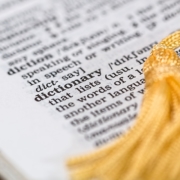
Peculiar words that made it into Duden’s 27th edition, the major reference dictionary of German language

The renowned dictionary for German language Duden, published for the first time in 1880 by Konrand Duden, recently printed its 27th edition.

This new publication covers and analyses extensively all the aspects of the German lexicon, including but not only, the grammar, spelling and synonyms. The peculiarity of the new publication stands in its introduction of 5000 new words that previously didn’t exist, building up a comprehensive dictionary of 1264 pages which reflect the influences that are shaping German language today.

The novelty: denglish and anglicisms

Gran part of the new terms included in the revised version of the dictionary emerge out of the social and political developments of this new century, defined in gran part by the entrance of social media and its impact on global communication. Peculiar is the blending of English and German, common to any english student in a German classroom, giving rise to a new language, commonly referred to as Denglish. Amongst the Denglish words that have made it in the Duden dictionary there are facebooken (to be on facebook), liken (to ‘put a like’) and emoji. Postfaktish is another interesting term which stems out of the contemporary fake news debate and the need to certify the validity and truth of a news. Other terms have instead remained in their english version, such as veggie, tablet, selfie, darknet, hashtag and Brexit.

The debate

The influence of English on the German language is a growing phenomenon, reflecting the developments of the German societal fabric. It is in fact in English that new words and terms have been coined to express global developments. Furthermore, regardless of the Brexit, it remains a commonly spoken language in Europe. Verein Deutsche Sprache, an organizations whose aim is to defend the purity of German language, had already expressed itself against the previous revised version of the Duden, which already in 2013 included different English-derived, or Denglish, words. The influence of English in German isn’t however a new phenomenon: already in 1880 Duden included 27 000 spoiled words and terms. Today, amid anglicisms and neologisms, the count has reached 145 000.

German neologisms

Amongst the new terms that have found their way in the dictionary are also German neologisms previously sought to as informal expressions, which now have been officially recognized and validated. To cite a few, Cyberkreig (virtual /online war) and Hasskriminalität (hate crime) are now new German words. Kopfkino (to daydream, or to be exact, to have an inner/mental cinema), Kopftuchstreit (the debate on the headscarf), Nachtshopping (to shop late at night) and Wildpinkler (one who likes to urinate in an outdoor setting) are other interesting terms. Also, Schmähgedicht (blasphemous or insulting poem), is a new term, coined by the comedian Jan Böhmermann in his recent ode to Turkey’s president Erdogan.
Furthermore, certain terms have received a grammatical revision. Amongst these, three English words influenced by German have been reintroduced in the dictionary in their original format. Majonäse returned to be Mayonnaise, as so has Ketschup, now Ketchup, and Anschovis, now Anchovies. With regards to the spelling, the most relevant changes consist of the introduction of dashes in words like Co-Trainer and Ex-Kanzler, and the introduction of the capital version of ß.

Cover photo  © CC0 Creative Commons


Want to perfect your German in a vibrant environment? Then take a look at the courses that Berlino Schule organizes by clicking here!

Being 20 years old: 7 German words that will describe your life

The German language is often seen as obscure, tough and hard to cope with. It’s true, a lifetime might simply not be enough for learning such a language, but what’s undeniable is the fact that German owns some words which perfectly depicts certain states of mind and feelings. That’s the reason why using those complicated-yet efficient terms will make you feel highly satisfied once you get to master the language.

Romanticism led many writers to look for the right words that could fully express their feelings for a society which was leading those young writers to the adulthood.

Schnapsidee. The Schnapsidee are ideas that usually come at night or in the early hours of the morning when you are in the company of other friends who are struggling to go home due to too much alcohol. The Schnapsidee just light up, are genial and often hidden by the desire to immortalize a particular state of exhilaration and carelessness during a successful night. When you have one, you end up bringing home a road sign , or a glass from the bar, a neon sign or whatever a drunk could wish for.

Mutterseelenallein.  Literally the word means “alone like a mother’s soul” and refers to a sense of discouragement and loneliness that even a mother’s proximity could not alleviate.

Hotel Mama. This expression is clear by itself. You are more 25 y.o. and still live with mom and dad, your desire is to become independent but, since you haven’t reached your autonomy yet, you need to accept some hard compromises and restrictions about your privacy. Another term used to indicate who lives with parents is Nesthocker: the abusive roommate of the mother’s nest.

Torschlusspanik.It is literally the “panic of the closed door”, that sensation felt when people around us reach relevant work positions, marry, create a family and we live our lives as we are twenty, afraid to engage ourselves in  demanding relationships which could have massive impacts  and consequences on our lives. It encapsulates, in short, all the anxieties and regrets for some chances we haven’t caught.

Lebensabschnittgefährte. It is the sentimental condition of those who do not want to or just fear to engage too much in a relationship and not be able to go back. The word literally means “the companion of a part of life,” perhaps not very romantic as a concept but many relationships are only suited to a certain time of life, the one in which everything is still uncertain, such as the city in which you live,  study, work. Moreover, if part-time jobs or fixed-term jobs both exist, why should love be meant to last forever?

Zukunftsangst. Being afraid of the future is something that we all share, but when you are 20 or almost 30 years old, you are overwhelmed by this kind of feeling. The world reveals itself to you with all its shades, its streets, as you remain motionless, uncertain about the path to follow, because at this point of your life you realize that dreams and projects you had when you were younger cannot be fulfilled or are too expensive to become real.

Lebenskunst. The Art of living. Overwhelmed by doubts, uncertainties, hopes, desire of satisfaction , young people  have realized that life should be appreciated for a whole set of small things that make it more enjoyable and less bitter, almost a true work of art. That’s why many young people want to explore new places, always looking for low-cost solutions, having fun during the week-ends with some friends until night, things you just cannot do anymore once you become a responsible adult.


Translation edited by Maria Cristina Odierna 

Italian version here.

Six concepts that German language can express in only one word

German as a language is well-known for the incredibly vast range of terms along with the great accuracy of its terminology, which often consists of many and difficult compound words; German-speaking people in fact are able to express structured concepts with only one word.

Using precise terms which perfectly express moods, feelings and sensations Germans and German vocabulary are famous for being both synthetic and efficient. Elsewhere we have already talked about beautiful words like Vorfreude, the joy of waiting, or Fernweh, the nostalgia of the other, of the far. This time we want to concentrate on six exceptional words – some fun, others more romantic and thoughtful – that once again show how German is a language that is also attentive to the smallest shades of the inner world of man.

Futterneid. Literally “food envy”, a feeling that we all have tried, at least once, at the restaurant (but metaphorically also in other contexts) when, after ordering a dish, we immediately realize that what our diner companion has ordered looks more appetizing and inviting.

Fremdschämen. A common feeling, experienced especially by the more empathetic ones. The verb and its noun refer to the sense of shame caused by somebody’s attitude, not ours. So when you’re brother will embarrass you, engaging himself in an awkward karaoke session while he’s drunk…well, German language has the perfect word for that situation.

Ruinenlust. This is definitely the most romantic word of the list, also from a historical point of you. The term refers to the pleasure felt while admiring ruined and crumbling old castles, relicts from the past which remind us of the ruthless flow of time.

Kummerspeck. Back to ordinary matters, this noun is related to the act of eating in order to find solace and consolation when we are worried, miserable or unfulfilled. When you’re gripped by negativity and you wish to plunder the fridge, well, think about this German word: Kummerspeck!

Sitzfleisch. Even the Germans do not let themselves be discouraged by long-term efforts, long boring activities, they rely on their perseverance to carry out large intellectual businesses. This term has something  to do with the slow constancy of the study, as shown by its literal translation: “sitting meat”. In short, whether you use glue or chains you need to stay “glued” to the chair for hours and hours in order to get good results.

Frühjarsmüdigkeit. Spring is, for many, the season of renewal, of nature and spirit. But sometimes, especially when the mind fails to support these changes or the body abandons the slumbers of April, it is easy to get caught by the Frühjarsmüdigkeit, the well-known spring fatigue  which pushes the lazy ones to wish for some sleep.


Translation edited by Maria Cristina Odierna 

Italian version here.

15 concepts that only Germans have

The language can say a lot about the people. And it’s a hard work to make a collection of a language’s unique words which could define the people’s soul. This is what Vanna Vannuccini and Francesca Pedrazzi did, both journalists and Germany experts in the book Piccolo viaggio nell’anima tedesca (Little journey in the German soul).

The two journalists consider German language as “difficult but with sharp subtleties and an incredible detail” and they mde a list of untranslatable German words (only for conceptual reasons). And through these terms they develop a wonderful portrait of the German people that somehow goes beyond the usual stereotypes but also explains them. Trying to answer the question “Who are these European cousins once soldier of the most terrible military tragedy and now absolute pacifist?”.

Here are the 15 words. But you can well understand their meanings only if you read the book which makes an actual reconstruction of the socio-political history of this country and a tour throughout its culture.

  1. WeltanschauungThis term, probably very famous in philosophy, has not real translation. The correct translation would be “vision/view of the world”. This word contains three others: God, Man and World. There is no there world, at least In Europe which has a similar word.
  2. Nestbeschmutzer: “The one who makes the nest dirty” is a person who messes up the environment where he/she belongs (family, church, party, homeland…). It’s an outrageous behavior which even animals would not have.
  3. Querdenker: The adjective “quer” means transverse/croooked with a negative sense. When compounded to “Denker” (thinker) leads to a negative consideration of a person. But in 1991 the Duden (the German dictionary) chose it as “term of the year”, claiming that thinking with your own mind can actually be a virtue.
  4. Schadenfreude: Maybe one of the most famous untranslatable German words… “the joy of others’ misfortune”. Since only Germans have this word, they could wonder “So are we the only ones who are happy for someone else’s disgarce?”. No, in this case it’s just honesty of German language.
  5. Zweisamkeit: Literally “loneliness for two”. It refers to when a couple is not interested to go out with other people. Something that we all know.
  6. Vergangenheitsbewältigung: It’s not a surprise that German has this word: probably no other country needs a “confront with the past” more than Germany.
  7. Männerfreundschaft_ Men’s friendship is different from women’s friendship. For this reason, German needed to create a term to specify a relationship made of few words but also esteem and sharing.
  8. Zweckgemeinschaft: The substantive “Zweck” means goal and when compounded, it often means something done for a certain reason. The Zweckgemeinschaft is the coalition for benefit, like two people that meet for sharing a hobby but “outside” they are not friends.
  9. Mitläufer: This is a beautiful example of Wortbildung (blending two words to make one, typical of German). “Läufer” is the one who walk, with “mit” (with) means a person who walks with others. It also means someone who adapts very easily in every situation.
  10. Feierabend: A nice word which means all the time and all the things done after work. Time that is important and sacred for Germans.
  11. Rechthaber: Stubborn, stoic and incapable of compromises: the Rechthaber is who always wants to be right. Maybe a bit common through Germans?
  12. Quotenfrauen: Gender equality is taken for granted in Germany but when a women is considered as “Quotenfrau” it is not a positive thing. It means when a woman is hired at job “only because she is a woman”. More because it’s a obligatory and not because she deserved it.
  13. Wanderweg: The verb “wandern” means “to go hiking”. With the word “weg” (path, small street), it means a path to do by feet. A real German passion for hikes…
  14. Unwort: What is the “not-word”? It’s the most hated word from Germans. Decided by the Gesellschaft für Deutsche Sprache  (the academy of German language).
  15. Zeitgeist:Very famous but difficult to translate, it’s the “spirit of time”. But what do Germans really mean?

16 signs that you are a master of German language

You attended a German language course. You spent hours doing homework and consulting the vocabulary. You forced yourself to listen to the radio and watching movies in German until collapsing on the keyboard. You abused Tandempartner/innen to have your daily dose of conversation. Well, it was really hard but it was worth it because now you are proud of your achievements and German is not a big obstacle anymore. You could even claim to “rock” the language without being denied. Some time ago, the English newspaper The Local made a list of the clear signs of being a German language master.

Berlino Magazine wants to make its own Top 16 too.

Shortening. Just like Germans, you use shortcuts such as Kuli for Kugelschreiber (ballpoint pen) or WM for Weltmeisterschaft (world cup). Well, if some German words have more than 35 letters, we have to find a solution anyhow.

Dialect? Kein problem. Dialect – for example Berlinerisch – doesn’t make you feel like a fish out of water anymore.

Jargon and idioms. You go beyond the simple grammar construction and you use Redewendungen (idioms) and Sprichwoerter (proverbs) and Umgangsprache (jergon). So if you want to say “not my business” you use <<Das ist aber dein Bier>>.

Enough Denglish. That dangerous mix of German and English is gradually disappearing and you can easily separate them.

Separable verbs. When you use a separable verb and you can reach the end of the sentence without forgetting which preposition you have to add (and especially, remembering that you HAVE to add a preposition at the end).

The grammar book is no longer useful. The grammar book is not open on your desk anymore but you use it for its original purpose: as a support for the book shelf.

Verbs with prepositions. Now it is easy to use the right preposition and case with verbs like leiden, sehnen, sich einigen. Same with articles, substantives and adjectives in the speech: it is not rocket science anymore.

The Konjunktiv I. When, reading an article you find the Konjunktiv I and you don’t think “look, a typo, so dumb!” because you know it is a reported speech.

You read newspapers. You can read local newspapers about the daily news on Die Welt or Suddeutsche Zeitung without taking ages.

You can read books in less than two months. You can finish a book before the author pass away. But, more importantly, you don’t need to underline the 80% of the words because you don’t know them.

Listening to the news. You’re able to listen and understand the news of Deutsche Welle avoiding the Langsame gesprochene Nachrichten, where the speaker is as powerful as a lullaby.

Netflix in German. You watch TV series in German. Ok, you did it before too with english subtitles. Then you switched to German subtitles. But now you don’t need subtitles anymore. And you don’t cheat watching Goodbye, Lenin! Cool, isn’t it?

No more endless thinking about what you are saying. The grammar rules that you used to hate now are crystal clear and start to be automatic even when you speak. So you feel free to talk and you realise you’re saying it right!

Real time chatting. When you have to respond on Facebook or Whatsapp to a person which you care about and it does not take the whole day to check the grammar correctness.

German dreams. Sometimes it happens that you dream in German. And not a fake German but a real German with correct grammar and perfect structures. You have to get used to that German has taken over your brain, even if you don’t want to admit it.

You enjoy your social life. When you go out with your German friends after a hard working day and it’s not a problem for you to speak the language with them. You can enjoy the conversation because it’s not a huge Hausaufgabe anymore. And you feel like home.