Lipsi, when DDR created a new dance to stop rock’n’roll

Listening to new rock bands was actually impossible for youngsters who lived in Soviet bloc

All western bands were strongly censored by the regime, above all rock’n’roll, which was not tolerated at all. Although listening to Elvis, Rolling Stones or Beatles was a weighty matter, the ban could be bypassed and their albums made it into DDR. The Soviet party’s chiefs worried about the fact that youngers were listening to this kind of music, so they decided to think a new dance up. The newborn dance was created to be caught on as opposed to rock’n’roll: Lipsi was born.

Soviet’s reply to the degenerate and vulgar Western rock’n’roll

Soviet leaders felt disconcerted by dances which kept spreading out since the end of the 50s. They believed that Elvis’ basin movements were almost pornographic; besides, a tête-à-tête dancing between teenagers was a not-well-identified danger for the social order. In order to prevent the leverage of this new kind of music over DDR teenagers, Soviet leaders were determined to compose new music and a dance, both to be suitable for the (chaste) education of Socialist youngsters. About Lipsi, René Dubianski composed the music, whereas the dance section was created by Christa and Helmut Seifert dancers. As reported by J.Elke Ertel in his book entitled “Walled In – A West Berlin girl’s journey to freedom, the name was not chosen by chance. All three authors came from Lipsia, which was obviously situated in the Soviet bloc. Adapting the Latin name of the city, Lipsiens, they created an original name: not without good reason, they thought that the final “i” would have given an “American” and new-fashioned guise, more fashionable for teenagers. Once music was composed and the dance was created, the strict Soviet censorship let it pass: the challenge against the capitalist West could begin on the dancing floor, too.

A guideline to dance Lipsi, for a perfect party in Eastern German style

Surely, you are now curious to know how to dance Lipsi, which is essential to organize a DDR themed party. The lyrics, composed by Dublansky and reported by Anna Funder in  Stasiland: Stories from behind the Berlin Wall, go like this: «These days all the youngsters dance Lipsistep, just it; These days all of them want to learn Lipsistep: it is hip rhythm! Rumba, Boogie and Cha Cha Cha are old-fashioned; out of the blue, a new rhythm has come from nowhere and it is about to be still». The piece is in 6/4, as it was a speedy waltz. The Seiferts created a very simple choreography which is quite similar to a rumba blended with waltz as defined by Ertel, so that it could be easily and quickly learnt by the youth. The most curious aspect was that any kind of basin movement was strictly forbidden, only chest movements were permitted. Dancers almost never got close to each other, keeping safe distance: all that contributed to create an “innocent” choreography. But even though it was beaten the drum for it, Lipsi didn’t hit the big time. Socialist teenagers continued to prefer Western rock’n’roll with its own unfettered rhythm and, listening to Lipsi, we can’t argue with them. If you want to learn more about the history of this questionable dance and about the everyday life during those years, you could visit the DDR Museum in Karl-Liebknecht-Strasse, Berlin.

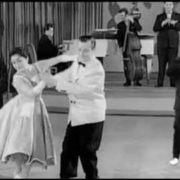
Cover image: A Lipsi step – Screenshot from Youtube’s video
 

Hermannplatz returns to its former beauty thanks to David Chipperfield

The department store located in Hermannplatz (Berlin – Neukölln) will be redesigned by David Chipperfield

The legendary building located in Hermannplatz, which dates back to the 1920s, will be knocked down and rebuilt by David Chipperfield. The palace can be found between Kreuzberg and Neukölln. In 1929 Karstadt wasn’t just a shopping center: it represented also a tourist attraction in the Weimar Republic. After the Second World War, the building was destroyed and later on built up. Today the facility belongs to an Austrian billionaire called Renè Benko. Now the billionaire wants to restore Karstadt’s builing and bring it to its former beauty. 

Karstadt from the 1920s to the 1950s

In the past, the Art Decò building stood on Hermannplatz, extending over 32 meters with 7 floors. The whole palace was made of limestone. Karstadt recalls New Yorkers’s store. During the 1940s the façade was destroyed. In the second half of the 20th century, the building has been refurbished. It didn’t, however, regain its glory.

David Chipperfield’s project

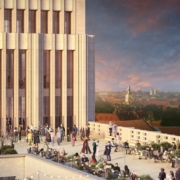
The British architect David Chipperfield will handle Karstadt reconstruction project. His aim is to give a modern interpretation of the building. As planned for the project, two columns will be reactivated. Furthermore, an observation deck will be added. Both in the first and second floor, a day care and a library are to be put up. The new structure will appear smaller than the older one even though gyms, offices and a covered market won’t be missing. On the top of the building, a restaurant and a hotel will be added. Construction works will last 3 years, starting from 2021. 

Photo: © Visualisierungen von der Vision des Projekts am Hermannplatz. Das Copyright der Renderings liegt bei David Chipperfield Architects.


How Dresden was rebuilt by its citizens, after being bombed in 1945

Dresden after the Second World War

February 1945. A few months before the end of Second World War, the city of Dresden was bombed. As a result of the conflict, Germany was occupied by Soviets. Just right after the Reunification of Germany and the Fall of the Berlin Wall, a tough work of reconstruction took place over the country. A group of Dresden citizens cleaned the rubble up and a lot of blueprints were drawn up thanks to the work of architects and urban planners. People wondered how the new city could appear and how it could be possible to rebuild it. In 1993, refurbishing works started in Dresden; almost ten years later, in 2005, the Lutheran church called Frauenkirche – which was considered the emblem of the city – returned to its people. Its wreckage has always represented a memoir against the war. Thanks to the citizen’s efforts, several important buildings were restored such as the Zwinger Palace and the Semper Opera House.

What happened during the bombing period

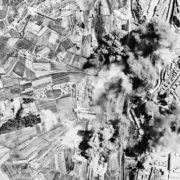
In February 1945, both Britain and U.S. Armies decided to drop two pounds of explosive and a thousand firebombs over Dresden. The air strike lasted two days no stop. The city of Dresden was destroyed by the flames. According to historians, 370000 people passed away during the attacks. The attacks in Dresden were known for their atrocity and then depicted in a novel called “Slaughterhouse-Five” by Kurt Vonnegut. 

Women called “Trummer Frauen” rebuilt Germany

The “Trummer Frauen” were a group of women who helped with the reconstruction of German destroyed cities. War reduced men’s workforce: husbands and sons died or never returned home. On their behalf, women took the reins of Germany’s cities restoration, being almost 7 million more than men. With their help, women freed cities from debris. The age of the so-called Trummer Frauen goes from 15 until 50. Moreover, allied powers issued an order for women to help get rid of rubble. A lot of volunteers joined and supported them. In different German cities like Berlin, Leipzig, Magdeburg e Nürnberg set out a plan for rubble removal. In Dresden, almost 492 men and 512 women took part in disposal operations. At the end of the 1946, the number of working women reached 580.

Photo: Wikilmages CC0

Nabokov lived in Berlin for 15 years, but he never integrated in the German society

Vladimir Nabokov moved to Berlin in 1922 and lived there for 15 years

Nabokov’s family moved to Berlin in 1920. In those days, many people left Russia because of the Civil war, and from 1922 to 1923 more than 300.000 Russians reached Berlin. Immigrats was mainly concentrated in Wittenbergplatz and Charlottenburg (this latter was ironically called Charlottengrad). Vladimir Nabokov was among those who arrived in 1922. His arrival was quite tragic: after just a few weeks, his father passed away while trying to save Pavel Miliukovl, a notable Russian politician, during an attack.

Life in Berlin

Nabokov spent his time within the Russian community, as he has never been able to integrate in the German society. In fact, he then admitted he could not stand Berlin. “Upon moving to Berlin I was beset by a panicky fear of somehow flawing my precious layer of Russian by learning to speak German fluently…”, as he wrote in his work Strong opinions, published in 1973. He stayed in Berlin till the late 1930s, when the rise of the Nazi party pushed him to move to the United States.

Literary debut

In Berlin, Nabokov wrote his first works in Russian and published them in some newspapers, which were printed by some Russian immigrants. His first book (Korol Dama Valet) was published by a Russian editor. He also translated in English a great number of books. In fact, the cultural hybridization shines through them: even though, those books belong to the English literature, styles and themes are typical of the Russian culture.

A guide to Berlin

A Guide to Berlin is one of those. This short novel, published in 1925, describes Berlin from the inside perspective, through the eyes of an unidentified character. The novelist believes in how important it is to immortalize everyday life: “So that could be reflect in gentle lens of future times”. The guidebook offers few reference points, which are concretely recognizable: narration is subjective and far away from a guidebook-style.

Here you can download Nabokov’s short novel

Photo: A Pictorial Biography, compiled and edited by Ellendea Proffer (Ann Arbor: Ardis Publishers, c1991).


Müller, Schumacher, Hoffmann: the secrets behind German surnames

The invention of German surnames

The use of German surnames became popular during the Middle Ages (between the 10th and the 11th Century), with the purpose of identifying the social status of people. Surnames were selected – like everywhere else in the world – according to physical, working and family features. Using a surname was very useful for census surveys.

Only rich families could afford a surname                                                                                                                                                                

Originally, the surname was widely used and it was considered as a people’s first name. After that, surnames were used to recognize the families’ origin. Having a family name was a prerogative of rich families, only. During the 12th Century, the use of surnames spread all over Europe, becoming common use everywhere.

How surnames were chosen 

During the Middle Ages, Germany started to use surnames according to people’s professions. Let’s make an exemple: Meyer was first used for rather important and powerful people; it was later adopted with the meaning of “farmer”.

A list of the most famous German surnames and their translations

  • Wagner – a man who deals with means of transit
  • Becker/ Beck – Baker
  • Bauer/ Baumann – Peasant
  • Hoffmann – Farmer
  • Schulz/ Schulze/ Scholz – Mayor
  • Koch – Chef
  • Richter – Notary
  • Klein – Little
  • Wolf/ Wolff– Wolf
  • Schröder – Driver
  • Neumann – Newman
  • Braun – Brown
  • Werner – Defense army
  • Schwarz – Black
  • Schumacher/ Schubert/ Schuster – Shoemaker
  • Zimmermann – Carpenter
  • Weiss – White
  • Krüger – Potter
  • Lange – Long
  • König – King
  • Krause/ Kraus – a man with curly hair
  • Huber – Landowner
  • Frank/ Franke – a man who comes from Franconia
  • Lehmann – Servant
  • Keiser – Emperor
  • Fuchs – Fox
  • Herrmann – Warrior
  • Thomas – Twin
  • Peters – Stone (Greek origin)
  • Stein – Stone
  • Jung – Young
  • Berger – Pastor (French origin)
  • Martin – Belligerent (Latin origin)
  • Friedrich – Peaceful
  • Keller – Basement
  • Gross – Big
  • Hahn – Plumber
  • Roth – Red
  • Günther – Warrior (Scandinavian origin)
  • Vogel – Bird
  • Winkler – Nook
  • Lorenz – Laurentius (Latin origin)
  • Ludwig –Famous
  • Heinrich – A person who belongs to an important House
  • Otto – Heiresses
  • Simon – Simon (Jewish origin)
  • Graf – Lordship
  • Krämer – Trader
  • Böhm – someone from Bohemia
  • Winter – Winter
  • Haas – Rabbits Hunter
  • Sommer – Summer
  • Schreiber – Writer
  • Engel – Angel
  • Brandt – Fire
  • Busch – Bush
  • Horn – Horn
  • Arnold – someone strong like an Eagle
  • Bergmann – Miner
  • Pfeiffer – Piper
  • Sauer – Sour

Photo: Gellinger CC0

Haus der Offiziere, an army base settled in south Berlin which has been working till the 90s      

Have you ever heard about Haus der Offiziere?                                         

Wunsdorf, Germany. Approximately 27 miles away from Berlin lies an army base called “Haus der Offiziere,” which stands for the “officers’ compound.” Opened in 1916, the building hosted Kaiser William II’s troops. Later on, it was used over World War II as a Nazi command center. The fortress “operated” until 1994, when the last soldiers permanently abandoned it.

Haus der Offiziere as Moscow secondment during the Cold War

Werner Borchert, 67 years old, works as a tourist guide in the building; the man claims that “Haus der Offiziere appears to be a tiny Moscow in a German territory.” In fact, during the Cold war the building became the center of the soviet army for the Eastern part of Germany. Inside the building were several facilities, such as a theater, a museum, a swimming pool, many barracks and different kinds of shops. The army base, approximately 4 miles wide, is surrounded by an eleven-mile-long wall and can contain about 40.000 soldiers. The complex still worked after the reunification of the country. Since the mid-1990s, the base has been abandoned and left unattended.

How the “forbidden city” appears today

During the soviet regime, it was almost impossible to reach the army base. Due to this reason, the building earned the name of “forbidden city” as German citizens couldn’t get into the building. Today, if you want to visit the ex-army base, it is possible to do so by booking tickets in advance. At the main entrance stands a Lenin statue; also, a set of Nazi vaults is to be found there. Currently, the base belongs to the federal state of Brandenburg; however, the building doesn’t have a real owner who can refurbish it.

Photo: Herr_Rettschlag CC0

Kurt Drummer: the most followed chef by DDR housewives

Kurt Drummer: a tv chef throughtout the DDR period

The Chef Kurt Drummer played an important role during the DDR period. In fact, he was the leading figure of a German tv program called “Der Fernsehkoch empfiehlt”, which means “Advice from the tv Chef”. The show went on air in 1958 on a television broadcaster service which belonged to the eastern side of Berlin. Over his 25-year-long career, Chef Drummer had the chance to undertake food science studies and to be a chef in a well-known hotel chain called Vereinigung Interhotel. Moreover, he won several international cooking competitions in London, Budapest and Vienna.

“Der Fernsehkoch empfiehlt”: Kurt Drummer’s tv show

Kurt Drummer was born in Germany (Gornsdorf) on 20th March 1928. He was both a Chef and a German showman during the DDR period, when almost 650 episodes of his show came out. Drummer started his career in August 1958. The first episode of the cooking show was called “Delicious fish meals”. Over the years, he released lots of episodes in which he showed people his recipes. Drummer’s tv show episodes usually went on every Saturday night and, in some occasions, on working days or in prime time. With a chef uniform and a white hat, Kurt Drummer shared his passion for food paying attention to its nutritional value. His advice was really popular among his audience. One of his suggestions was to use one ingredient rather than another: for instance, margarine instead of butter to make brown bread.

The tv show ending

The cooking show “Der Fernsekoch empfiehlt” was really appreciated by DDR housewives. Thanks to the easy and healthy recipes presented during the show, people enjoyed Drummer’s work. The program was interrupted in 1983 due to Drummer’s health problems. The chef explained to the spectators that he had no longer energy to fetch ingredients and come up with new recipes as stated by the tv contract.

Photo: Pexels CC0

Inka Grings: the first female coach of a German men’s team

Inka Grings: the first female coach of a German men’s team

Inka Grings becomes the first woman in Germany coaching a men’s team. She was both an ex-football player of the German National team and a technical supervisor of a female soccer club called Duisburg. From now on, she is officially involved in the SV Straelen a team which stood the fourth tier in the Oberliga Nordrhein. Her nomination was taken into account thanks to her ex-Football coach, who proposed her candidacy.

The woman who replaced Hermann Tecklenburg

Hermann Tecklenburg, the old coach, relieved of his charge, seems to have failed the expectations of the team supporters, and backed the candidacy of Inka Grings. The woman, ex-football player, is recognized as the most high-scorer player of the Bundersliga. Also, Martina Voss, who currently coaches the German National team, supported Grings’ candidacy. Germany is getting ready for the first woman on charge that coaches a men’s team. But that’s not all, because also France and Italy have already several women who coach men’s team.

From being a player to coaching

Inka Grings career starts in 2014, when the first female football team has been set up by the MSV Duisburg. Thanks to her technique, she carried her team from the youth field till the Fußball-Bundesliga. Between 2016 and 2017, her team gained the Bundesliga.

Photo: jarmoluk CC0

Franzbrötchen, the German croissant born as rebellion against French occupation

The flattened croissant: traditional pastry of northern Germany come from historical conflict

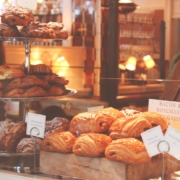
The Franzbrötchen – literally “french roll”- is a classic pastry of Hamburg commonly found in the northern Germany, including Berlin. It looks like a croissant, but has a flattened shape with more strong flavour due to the addition of cinnamon. Its birth can be trace back to the early 1800s and seems to be connected with the siege of Hamburg city by Napoleonic troops.

Born as “pacific rebellion”

During the French occupation (1810-14), Hamburg was pushed to modify its own confectionery tradition. Indeed, the Napoleonic troops, being nostalgic of homely taste, wanted local bakers to make croissant. However, the outcome was far enough away from the original pastry, as can be experienced tasting the Franzbrötchen. There are two possible explanations about it. The first one is that the German bakers weren’t good at recreate the softeness of French pastry, accustomed to use more heavy dough compared to. Based on Atlas Obscura, it could be another one which is much more sneaky.  Likely, Hamburg bakers pretend to misunderstand the French request and, as a gesture of “pacific rebellion”, supplying a “german-style croissants” to enemy soldiers, with addition of cinnamon.

The recipe

Without regard to different hypothesis, Franzbrötchen is still today an enjoyable pastry to bake and eat. We show you below a version of  its recipe.

Ingredients (6 serves):

For the dough:

  • 300 g flour
  • 1 egg
  • 35 g softened butter
  • 35 g white sugar
  • a pinch of salt
  • 1/4 small cube of fresh yeast
  • 125 ml warm milk

For the stuffing:

  • 35 g softened butter
  • 35 g white sugar
  • 1 teaspoon of cinnamon

Directions:

Combine flour, egg, butter, sugar and salt in a big bowl. Dissolve the yeast in warm milk, then blend into the rest of the ingredients and knead until smooth. Cover and let rise about an hour. Next, roll out the dough on workbench and smear softened butter on the surface. Using a teaspoon, sprinkle a mix of sugar and cinnamon. Roll up onto itself and then cut transversely into slices with an angle of 45° in the shape form of trapezium. Place on baking sheet and slightly press in the middle of each section with handle of a wooden spoon. Bake in the oven at 180 °C for 20 minutes. Et voilà, ready to taste! 😉

Pexel  CCo creative commons

German flag

All you need to know about the German flag

The origin of the German flag

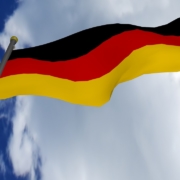
If you want to trace the birth of the German flag, you need to go back to the 18th century. During that period, Europe started to put together several former states. In the past, coats of arms were used to identify a dynasty or a land. Germany occupied a wide territory and was made of several members. Some of them were more powerful than others, like Prussia and Austria. Also, the Holy Roman Empire exerted a limited influence over the lands, ran by different dynasties. The German flag typically depicted in black, red and yellow as we know it, appeared for the first time in 1832. The selection of these three colours represented a choice made by patriots to identify themselves as a group with clear political ideas. However, this choice also reflected a sort of compromise among patriots; even if they were democrats, part of them regretted the Emperor’s leadership, the symbol of which consisted of a black eagle drawn on a yellow background. Red and black instead, stood for people who wanted to get rid of Napoleon’s authority.

Black, red and yellow: the German flag colours

The idea of a unified German state came out during the 19th century as a protest against the French emperor Napoleon I. During that period, new colours were selected, such as black, red and gold. Nevertheless, the vast majority of the former states refused to gather all the states under a single one; in a certain way, democracy was considered as a risk. German history recalls a revolutionary period between 1830 and 1870, when the industrial revolution was setting out, too. Unemployment, poverty and bad harvests were just a few reasons that put up several insurrections. The golden colour, which was widely used for flags, was replaced by yellow, which together with black and red, created a distinction between Nationalists and Democrats. Over the years, the flag became a symbol of the 1848 Revolution, the aim of which was to obtain democracy. When the revolution failed, colours were banned.

German reunification and flags of the new country

A unification became necessary to release Germany’s own economy and to avoid constraints and customs blocks. Prussia, which at the time was guided by Bismarck, pushed for freedom. Bismarck was a former politician, who worked to embitter political relations with Austria and marginalize it. Furthermore, he moved against France, which represented Germany’s historical enemy and also a major power of that period. In 1871 Germany was unified and Bismark chose new colours for the nascent state’s flag, such as black, white and red. Today’s colours of the German flag came into force in 1918 with the rise of the Republic and the Emperor abdication.

From Hitler’s period till nowadays

When Hitler rose to power in 1933, a new symbol thrust upon Germany. A black swastika with white and red colours in the background appeared. The third Reich colours were black, white and red. Ever since 1935, all symbols were forbidden with the exception of the Nazi one. With Germany’s division in 1949, DDR government adopted the classic flag colours (black, red and golden) adding three symbols: a hammer, which represented workers; a divider, which represented intellectuals; and a spike, which represented farmers. Germany Federal Republic adopted some colours without any symbols. After the unification, the last flag became today’s German flag.

Photo: marselelia CC0