Schlagwortarchiv für: german language

50 steps to become the perfect Berliner

Today we would like to talk about a very special book, How to be German (in 50 easy steps). It is an unpretentious manual whose intention is to transform the reader in a perfect teutonic mutant, with all the merits, tribulations and idiosyncrasies that derive from it. Supported by ironic illustrations for each step it is written in German and English.

The approach is utterly ironic and amusing, and the 50 steps to follow span from the Apfelsaftschorle to German bureaucracy, to the much-hated GEMA to living bio, the fines on public transport, all the way to the beloved Kartoffelsalat. It also talks about the sacredness of Tatort on Sunday evenings and the importance of greeting cards for any special occasion. A spiritual compilation that has cheered my first U-Bahn trips and most often ripped me off in laughter in the religious silence that reigns on wagons, stirring up the discreet curiosity of my taciturn traveling companions who, after having looked at the title in cover, understood the reason of so much hilarity and would often exchange a smile.

The author, Adam Fletcher, is a Cambridge blogger and marketing expert who has been in Berlin for some years now; on his official page he describes himself as “a writer, an amateur chocolate eater and a professional napper,” as well as author of three enjoyable volumes such as “A Picnic for Perverts” (2012), “The Hipster Guide” (2013) and “Denglish for Better Knowers” (2014). After the tragicomic closing of Neukölln’s Hipstery store, Adam continues to write his satirical pieces and sell his line of gadgets through e-commerce, narrowing the target and type of products that he and his partner smuggle under a single, exhaustive label: “things that make us laugh.” The kit of the perfect Berliner hipster is one of the most genius and hilarious finds I have ever found. Take a look at yourself, if you do not believe it.

15. «MAHLZEIT!»

German has the reputation of being a pragmatic and literal language. Both nouns – like the nipple, for example, that was renamed with the romantic Brustwarze (“wart on the chest”), and the too explicit Antibabypille – and some of its expressions, which sometimes seem to describe not a mood or a state of mind, but the mysterious mechanics of an invisible car: “Es mennuft” (“works”), “Es geht” (“goes”), “Es passt” (“its fits good, it adapts”) , “Alles in Ordnung” (“all in place”).

This can serve as an appetizer, intrepid Ausländers, but to become real Germans you must learn to use the most pragmatic and disconcerting greeting of all – “Mahlzeit!”, Translated with “have a good meal!” or more literally with “meal time”. I had just arrived in Germany and while I was sitting in the canteen for lunch, my colleagues walked by the door and said to me, “Mahlzeit! ». Mahlzeit? Mahlzeit? Lunch time? Well, no doubt! That I’m eating is obvious. Right now I am clearly and loudly swirling a potato salad. I’m chewing, don’t you see? I know it’s a bit early for lunch, but I admit I missed breakfast. Do not judge me, have pity, please!

Only then do you understand that it is not a question. It’s a redundant, clumsy disguised statement, like a kid playing and stealing clothes from its parents, a form of greeting. So, for the sake of integration, over time you will start using it too. At first, it will sound a little bit weird, but I assure you that after a while you will find it rather fun, especially since in many regions of Germany you can use it at any time of the day. You can call someone at 4 am when you know for sure that they are still sleeping and wish them “Mahlzeit!” Brilliant. Perhaps you are wondering why you can’t add the -zeit suffix to other activities to create new and original greetings. But German literacy begins and ends just when you start to grasp its meaning. Glove is Handschuh (“hand shoe”), but do not dream of calling the Kopfschuh hat (“head shoe”). Do you see someone drinking? You can not wish him “Trinkzeit!”. You neighbours are having sex and don’t even bother covering up the moans? It is not admissible to ring the bell and wish them a warm ‘Fickzeit!’

Only «Mahlzeit», understood?

(Adam Fletcher and Ingo Herze, How to be a German/ Wie man Deutscher wird, Verlag C.H.Beck oHG, München 2013, pp.23-24)


Want to learn German in a vibrant environment? Look no further and check out the German courses that Berlino Schule organizes by clicking here!

 

Four German words that have no direct translation

It’s called Found in Translation and it is a very interesting graphic project realized by Anjana Iyer, presented in occasion of the initiative 100 days Project (The repeating of a creative task for 100 consecutive days and recording of each days efforts).

At the heart of the illustrations of this graphic designer from New Zealand are words that have a unique and original meaning which exists only in one language. There is no direct translation, more words are required and at times, as she did, also a nice drawing. It is through these that she tries to explain the meaning of these untranslatable words in other languages.

Rightly so amongst this list there are also some German words. Do you know of a word that is capable of conveying the German Fernweh, or so the longing of a place one has never been to? And of the German Schadenfreude, the “pleasure derived by someone from another person’s misfortune”? And what about that face that you would like to slap that in Germany is simply address through as Backpfeifengesicht? We too have forests, but perhaps since we never had the Grimm brothers we never felt the need to describe the feeling of being alone in amongst the trees as Germans did with Waldeinsamkeit.

————————————–
Do you wish to learn German or perfect your knowledge? Then take a look at the German courses that Berlino Schule organizes in Berlin here!

5 absurd rules of the German language that once mastered make you feel complete

It’s not enough that it is a language with thousands of inflexible grammatical rules, with words that have a difficult meaning to perceive and sounds at times almost impossible to pronounce. German, despite its reputation of being a rational language, at times presents cases when these rules are not rationally justified and lead to absurd paradoxes. And for us wretched born under another mother tongue, but have to learn how to live with German, there is nothing left to do than to fight against these absurdities every day.

1. The gender of certain nouns

Skirt is male, girl is neutral. For English speakers this is a very confusing situation and the only way to survive out of it is to forget the universal the and simply accept the ambiguous gender assignment for German nouns. Although there are certain exceptions, for instance words that end in -ung are always feminine and those that end in -er are masculine, most of the nouns articles have to be learned by heart because there are no rules to rely upon. And in this condition of anarchy yes, you will have to learn by heart every single common noun of things, animals and so on. Wouldn’t it be nice if the gender was at least deductible from the meaning of the word? Yes, but no: because a skirt is male, and a girl is neutral.
Not to talk about the chaos caused when universal nouns that belong to the collective imagery not only have a gender in the German world, but also a quite confusing one. So then we have the moon (der Mond- M), the sun (die Sonne- F) and death (der Tod-M), as we learned from that famous scene of a chess match against death in the swedish movie The seventh seal. Yet again, this is a different story…

2. Two-digit numbers

Counting in German is easy, but only until 20. Because from 21 onwards a tremendous rule kicks in by which numbers are read at “reverse”. It’s not twenty one, but one-and-twenty (einundzwanzig), it’s not twenty two but two-and-twenty, it’s not sixty seven but seven-and-sixty. Reading the number from the tenth before the unit forces a different way of thinking. In certain workplaces in Germany, those characterized by a majority of non-Germans, reading numbers in this way is forbidden. So to pronounce numbers in a way that is clear and understandable to everyone has led to the forming of a sort of baby talk by which you have to pronounce every digit once: 83 is eight-three, 98 is nine-eight… The problem arises when a German client calls you in and you get a 17 digit Amazon order pronounced overturned and at the speed of light. At that point there is nothing left to do other than rolling up your sleeves and getting to work…

3. Dates

The problems with German numbers aren’t over. For unexplainable reasons, these people invented an entirely original way of reading the years of a date. First thing, the first two digits are separated from the last two. So far so good, as we have the same system in English. In German however amongst the two groups of digits they place a hundert (hundred). Neunzehnhundertzweiundneunzig. The again, why hundred? Possibly because it implies the calculation 19×100=1900 (obvious much?), or possibly because it is a way to distinguish dates from normal numbers. The choice is however debatable. For our luck the dawn of the new century saved us all: from 2000 onwards they gave up to read zweitausend, zweitausendeins, zweitausendzwei… Twothousand, twothousand and one, twothousand and two…

4. Separable verbs

Verbs in English have a preposition. In German instead the prepositions are stuck directly to the verb, thus creating a myriad of countless words that have the same root but different meanings, filling up the already well-supplied dictionary. In this way the same verb can mean everything and the opposite of everything: nehmen (to take), according to the prefix it has at the front may mean to accept (annehmen), to remove (entnehmen), to lose weight (abnehmen), to gain weight (zunehmen), to behave (benehmen)… Combined with the fact that almost all of these prefixes are separable from the verb, and that often the separate prefix may be moved at the end of the sentence, make it so that you can never know what a person is trying to say until he utters the last word. An example?
“Ich gebe die Aufgabe… ab.” I hand in the task.
“Ich gebe die Aufgabe… auf.” I give up the task.

5. The rigid position of the components of a sentence

I often thought that writing a phrase in German is like playing a tetris. Yes because in this language every component of the sentence has its own rigid position that must be respected, which also varies according to the type of sentence: when asking a question the conjugated verb has always the first position, in a positive sentence it has the second position, in a subordinate sentence it occupies the last position (and here we go back to the aforementioned problem by which until the person in front of you has pronounced the last word one can’t know what he means). But not only. The subject will always occupy the first position in a positive sentence unless, usually, you want to start with an adverb for instance, which in that case requires to make an inversion. And so on. The strange thing is that this is a feature of languages that don’t have cases, whereby the role of the components of the sentence is defined by their position. German decided instead to keep both: cases and positions. The best part will be when you’ll move to the most advanced grammar rules and find out that there is also a predetermined order to position the various complements. It is called TeKaMoLo and no, it is not a new generation medication, but it’s the key to remember the order of the complements: Temporal (when), Kausal (why), Modal (how) and Local (where).

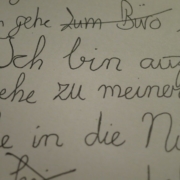
Photo: “Practicing my old school writing for German class” © Alper Çuğun – CC BY SA 2.0

——————-
Do you wish to learn German or perfect your knowledge of the language? Then take a look at the German courses that Berlino Schule organizes in Berlin here!

5 TV series that can help you perfect your German

When deciding to learn a new language, the first thing that comes to mind is to find an adequate language course that can ideally fit in our everyday schedule. But what about a good TV series?

Lessons are undoubtedly a fundamental point for departure when learning a language, but at times it might not be enough. Learning a new language means accessing to a new way of thinking, opening our mind to a new culture. Essentially, learning a language implies not only knowledge of the grammatical rules and the lexical, but also knowledge of the so-called pragmatic language, everyday expressions and spoken terms. If one doesn’t have much contact with native speakers, watching TV series in the original language can be a very useful means through which one can learn new expression. Terms that we would otherwise not know of through a strictly theoretical study. For this reason we would like to propose a few German TV series, very different from one another, that might help you further your knowledge of German.


1. Türkish für Anfänger

“Kebab for breakfast” is one of the most notorious German productions. The series, which lasted for 3 seasons, it set in Berlin, the German city with the highest concentration of Turkish citizens. The storyline is about an enlarged family made up of a Turkish man and German woman, both with adolescent kids. It is a funny series, that opens a window on Berlin’s multiethnic social fabric. It is suitable both for young people and adults. In 2007 it won the Civis Media Prize in the entertainment category for having promoted the integration of family that have a foreign background.


2. Stromberg

Stromberg is one of the most appreciated German TV series. Five seasons that tell the story of Stromberg, a manager of an insurance firm by the name of “Capitol Versicherung AG”. It is the German version of the American series The Office, portraying life in the office in a funny way. This series, however, is not advisable for beginners due to the fact that a lot of the irony derives from word games. It remains nonetheless a rich source of everyday expressions.


3. Gute Zeiten, schlechte Zeiten

It is a German soap opera of 1992 that had a 6 million audience count. The story is set in an imaginary neighbourhood in Berlin and it recalls the Australian series The Restless Years. Unlike other soap operas that portray the life of families belonging to a high social background, this one focuses on the life of young people and for this reason it is very appreciated by a younger audience.


4. Tatort

Tatort is a police genre TV series. It is the longest one as it has been broadcasted since 1970. The commissioners are at the center of each episode, lasting about 90 minutes. The episodes are quite plausible and, unlike other police series, the various regional broadcasters of ARD are responsible for their territorial spheres and their investigative theme. The series is shot in different cities in Germany. Berlin, Munich, but also in other countries, in Vienna and Lucerne. For this peculiarity it is very useful to learn different accents, to know more of the city and to get an idea of German speaking countries.


5. Die Sendung mit der Maus

Der Sendung mit der Maus is one of Germany’s most famous animated series. It was first aired in 1971 and it is intended specifically to a young audience, between 4 and 9 years of age. Following it is also very useful for who doesn’t really know the language and finds more comfort in linear stories. This TV series has been recalled “the school of the nation” precisely due to the way it helps its audience to learn and assimilate the fundamental lexicon in different settings, from history to science.

Cover photo: © Youtube
————————————–
Do you wish to learn German or perfect your knowledge? Then take a look at the German courses that Berlino Schule organizes in Berlin here!

German? It’s becoming easier, thanks to foreigners. A look on how it’s changing

Linguists call it Kurzdeutsch (abbreviated German) or Kiezdeutsch (German from the neighborhood, a less common denomination) when referring to the variations of the spoken language as opposed to the standardized version found on books and practiced in language classes. Anyone approaching the study of German might have a hard time with the declination of articles, the adjectives and prepositions, to mention a few. German is known for its morphological and syntactic rigor, an element that when learning a language can be a double-cut sword: what at first may seem an insurmountable obstacle, namely the assimilation of the innumerable rules to be respected, may well be an advantage. In fact German is a language with few exceptions, in particular if compared to many others (Slavic languages, for example). But this standard German with infinite rules and few exceptions is very different from the everyday spoken language on the streets of any German city. Dialects, accents and different registers have led to the building of multiple language variations of the language. Amongst these, Kurzdeutsch, which makes simplification its defining characteristic.

The salient features of Kurzdeutsch are the omission of articles and the removal of crasis (for instance in the fusion of prepositions and articles as in the case of ins, zum, beim or zur). Kurzdeutsch is the linguistic variation typical of bilingual or second-generation or third-generation migrants: other distinctive traits are the influence from Arabic or Turkish language (eg Yalla or Lan) and the transformation of German sound ch (non-existent in Turkish) in sch.

As reported from the Die Welt, linguist Diana Marossek published a book from the title of “Kommst du Bahnhof oder hast du Auto? Warum wir reden, wie wir neuerdings reden” (literally translated into “Are you coming to the station or do you have a car? Why we talk the way we talk recently). Through the listening of the language spoken in the subway, in classrooms, in public offices and supermarkets Marossek’s book proposes an empirical study of Kurzdeutsch which, as she concluded, has become quite literally a “trend”. As she observes even the most proficient of linguists have begun to adopt certain Kurzdeutsch expressions. There are two ways to view the spreading of Kurzdeutsch: whereas on the one hand it might simplify access to the language, on the other it actually it be seen as a weakening of standard German, which although very rigorous, is important to know in every field, from the academic environment to a business setting.


Cover photo: School © CollegeDegrees360 CC BY-SA 2.0


Do you wish to learn German or perfect your knowledge? Then take a look at the German courses that Berlino Schule organizes in Berlin here!

Berlinerisch, a small dictionary of the Berliner language

If it is true that in order to understand the culture of a place you have to know the language, it is essential to understand the dialect spoken in our beloved city: the Berlinerisch.


This folkloristic dialect, known for its sarcastic and often rude tones, is loved by many in Germany. Adored by the Berliners, it is a blend of old spoken dialects in urban centers, which in the past formed the city of Berlin. It also comes from the Berliner Schnauze, the typical berlin doc character.


The Berliner language

Some polls reveal that the Berliner language is very much in vogue among the new generations and is even turning out to be one of the most talked about in the city. So if you want to keep up with the times and understand what your interlocutor is talking about, here are some examples of Berlinerisch:

ich: ick / ikke (me)

aber: aba (or)

auch: ooch (also)

auf: uff (above)

etwas / was: wat (something)

ein: een (indefinite article, masculine, singular)

gehen: jehen (go)

gucken: kiek’n (watch)

klein: kleen (small)

laufen: loofen (walking)

nein: woman / nee (no)

nichts: nüscht / nichs / nix (nothing)

Schnauze: Schnute (1. mouth, 2. face / animal face)

das: dit / det (1. determinate article, neutral, singular 2. this)


The most common linguistic tendencies are to transform the “s” into “t” (was> wat, das> det, alles> allet) and the “g” in “j” (gut> jut, gehen> jehen, genau> jenau)

As for the ways of saying:

Allet comes! (Alles gut!) = Everything is alright

Moin! (Guten Morgen!) = Good morning

Du Alta! (Du Alter) = Hey you!

Eyh, jeh ma nich uff’n Keks! (Lass mich in Ruhe!) = Don’t annoy me, leave me alone! (literally “do not stay on biscuits”)

Is aba warm heute, huh? (… nicht wahr?)=  It’s hot today, right? (At the end of the sentence, it means “true”)


One of the main features of this slang is the linguistic register, such as eating letters in the middle of words or dropping the final part

ist> is (is),

komm mal> komm ma (come)!


Some of Berlin’s typical particularities are the acronyms:

j.w.d. > janz weit draussen = a far away place. Could be translated “in the midst of nothing / the wolves”

Kotti, Alex, Rosi, Schlesi =  Kottbusser Tor, Alexander Platz, Rosenthaler Platz, Schlesisches Tor.

Vokuhila > vorne-kurz-hinten-lang = short in the front and long in the back. One of the most popular hair cuts in Germany between 1982 and 1987, also in the most punk “Volahiku” version (long in the front and short in the back).


Cover photo: © Daniela Spoto


Are you living in Berlin and wish to perfect your knowledge of German? Take a look at the courses that Berlino Schule organizes!

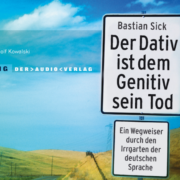
“The dative is the death of the genitive”, the book where Germans make fun of their own language

Is it possible to combine studying and careful attention to the proper use of the language whilst having fun?

But above all: is it possible to do so with the German language, generally considered one of the most difficult to learn due to its lexicon and rigid grammar that recalls the  Latin one? The innovative German grammar booklet “Der Dativ ist dem Genitiv Sein Tod” (translated “The Dative is the death of the Genitive”), made up of 6 volumes published by Kiepenheuer & Witsch between 2004 to 2014, seems to have been able to do that perfectly, given that for the first time ever a language manual has managed to become an international bestseller with over 3 million copies sold.

Sebastian Sick, The dative is the death of the genitive

The author of this achievement is Bastian Sick, curator of the linguistic column Zwiebelfisch on Spiegel Online: the German term Zwiebelfish indicates those letter of a text that by mistake are reported in a different character compared to the others; Sick chose the term Zwiebelfisch as a title for his column as a metaphor of the German phenomenon of using words and expressions that would formally be incorrect. Journalist, entertainer, but especially a humanist specialized in history and romance philosophy, Sick began his career as a translator and interpreter: his passion for German language and grammar has allowed him to achieve a fine awareness of the language that is hard to find amongst professionals of the academic world and schooling staff. The title of Sick’s work “The dative is the death of the genitive” alludes to the grammatically incorrect replacing of the genitive with the dative in a lot of current German expressions. The same expression “Der Dativ ist dem Genitiv sein Tod” is grammatically incorrect, yet spread widely following the publication of the work. The 6 volume collection is a compilation of the articles published in Sick’s coloumn Zwiebelfisch.


The method

The case studies selected by Sebastian Sick aren’t tailored expressions, literary texts or lists of rules to learn by heart, but sentences that derive directly from conversations amongst native speakers, road signs, advertisements or newspapers. Sick deals with great humor certain grammatical, spelling and pronunciation cases that are common in modern day spoken and written German. Everyday life becomes the occasion through which even those whose first language is German have a chance to reflect and talk about  it with friends and acquaintances without having to resort to dusty toms stored in the library. At the same time Sick’s approach is also good for those who are new to the German language, but wish to know the nuances they often miss during frontal lessons. Sick’s work is one that aims to convey not only the rules for a good use of the language, but also the pragmatic, whose traditional study is often difficult to understand even within an academic environment. At a time where we are all coming to the terms with having the best results in the shortest amount of time, mistakes are demonized to the point of making us forget the universal truth that lies within the saying “one learns through mistakes”. Highlighting mistakes and analyzing them with the right lightness and irony, without falling into strict academic rigorousness, silencing the shame and fear of making another mistake, allowing you to better accommodate the corrections and learn the language effectively.

The opinion of the readers

Precisely due to its innovative features, “Der Dativ ist dem Genitiv sein Tod” hasn’t been welcomed warmly by everyone. Some appreciated Sick’s style and humor to the point of having integrated his manuals within the bibliography to prepare for German exams, others have instead condemned him for his method of analysis. Others have even spoken against it becoming an school text, as deemed not to be fit for students. As for any language manual there will never be a universally positive judgment, however one must recognize certain unique aspects of Sick’s work. In the first place he has a real talent in getting the reader’s attention on the topic, considering that it is not of the most approachable. In the second place is his focus on the modern day use of the language, which is ever more important to foreigners arriving to Germany right now. There will always be the fans of the “purist” language, that spend their time correcting the common use of new grammatically incorrect expressions, however given that every spoken language has a life of its own maybe it is time one accepts Sick’s lightness and irony: debating about mistakes, neologisms, of the most uncommon expressions can contribute in helping speakers to become more aware and conscious of the language’s mobility and variations.

In the meantime, if you wish to test your knowledge of the language, you can try to answer the following quiz available on Sebastian Sick’s private page!


Are you new to the language or have studied a bit of it and wish to perfect it? Take a look at the German courses that Berlino Schule organizes in Berlin!

10 useful German expressions for everyday life

German can seem tough at first listening (sometimes at the second too…), but with study, practice and commitment you can get great results and become fluent speakers. At this point, there is still one step to go through that will make the difference: learning common expressions of the spoken language, those that almost never appear in grammar books, but that are very useful when interacting with native speakers. As follows is a list of German expressions to learn by heart selected by Matador Network.

1. Das ist bescheuert – It’s ridiculous!

The literal translation of bescheuert is “insane” or “crazy”, but in everyday language this term is used negatively, to indicate something that you don’t like. For example: if you organized a barbeque in the park and it starts to rain, “das ist bescheuert” is the correct exclamation.

2. Na? – So…?

Amongst people you know very well you could use it to substitute the classic “how are you?”. A second use of the expression is to ask (indirectly) how something went, for example the result of an exam: “so? (how did the exam go?)”. “Na” must not be confused with “na und?” which could be translated into “so what?”, which has a more provocative and intolerant tone.

3. Das is mir Wurst – Doesn’t interest me / What do I care

Literally it means “for me it’s sausage”, but the meaning is “it doesn’t interest me”, “what do I care”, “it’s the same for me” up to the stronger “I could not care less”

4. Ich besorge das Bier – I’ll get the beer

Besorgen means “to take care of” or “to get something”, more informally, and this is what it is meant in this expression. “Ich besorge das Bier” is definitely very useful in a nation where Beer is the most popular drink (as we talked about in this article).

5. Kein Schwein war da – Nobody was there

Schwein means “pig”, but this noun is used in different German expression and assumes a completely different meaning: in some cases it is employed derogatorily whereas other times it is used in a colorful and emphatic way. Some examples:

Kein Schwein hat mir geholfen: “nobody helped me”

Armes Schwein: “poor thing!” (in a compassionate way)

Schwein haben: “to be lucky”

The term appears also in some neologisms:

Eine Schweinearbeit: “a hard work”

Das kostet ein Schweinegeld: “that is excessively expensive”

ATTENTION: if you scream “Schwein!” at someone, you are still calling them a “pig”.

6. Der spinnt – He’s crazy

In German the verb spinnen means “to spin”, but in the course of evolution of the language this verb has also become a synonym of “being crazy”. It is thought that this meaning to spinnen might derive from the fact that years ago spinning yarn was a hobby conceded to patients of mental health institutes.

7. Langsam langsam – Little by little

The translation of langsam is “slowly”, and when it is employed as langsam langsam it conveys the proceeding little by little, one step at a time.

8. Das kannst du deiner Oma erzählen – Tell your grandmother

Literally. And you can use it to reply to your friend when they’ll promise you that this weekend they won’t touch a drink!

9. Null acht fünfzehn (0-8-15) – In the average

0-8-15 was the standard rifle used during the First World War. This concept has remained in the spoken language as a synonym of mediocrity, used in the valuation of something that remains below average. For instance, “wie war der Film?” “ach, null acht fünfzehn”

10. Ich habe die Nase voll davon – I’m sick of it

The literal translation is “my nose is full”, to indicate when you are fully fed up of it (like Anastasia sang). For example: “ich habe die Nase voll von seinen Lügen” (I am sick of his lies)
————
Are you new to German and you’re starting to get intrigued? Or have you already studied a bit and you wish to perfect your knowledge? Then take a look at the German courses that Berlino Schule organizes in the heart of Berlin!

10 really long German words that are impossible to pronounce without making mistakes

German is (in)famous for its long words.

Speaking properly in German gives a lot of satisfaction, but it is undoubtedly a hard language to learn for foreigners. This time we propose a list of ten of the hardest German words to pronounce without making mistakes. There aren’t many phonetic rules in German, but the fact that:

  1. the words can be very, very long (adjectives, nouns and conjugations at times are put together in the same word)
  2. there are several consonants at times following one another without even integrating vocals on which one can ‘rest’ upon

making the pronunciation of certain words almost impossible.

The following list of 10 words includes everyday expressions and also old-fashioned terms, which are however present in dictionaries. The meaning of some of these contributes to the understanding of the attention that Germans pose on the accuracy of the meaning of the words.

Anyways, the game is another: are you capable of pronouncing out loud all ten words without making mistakes?

10. Freundschaftsbeziehungen

Friendly relations

9. Kraftfahrzeughaftpflichtversicherung

Motor vehicle liability insurance

8. Bezirksschornsteinfegermeister

Regional chief of the chimney sweepers

7. Betäubungsmittelverschreibungsverordnung

Regulation for the prescription of an anesthetic

6. Rechtsschutzversicherungsgesellschaften

Insurance companies that offer legal protection

5. Streichholzschächtelchen

Small box of matches

4. Donaudampfschiffahrtsgesellschaftkapitän

Chief of the vapour expedition company on the Danube

3. Wachstumsbeschleunigungsgesetz

Growth acceleration action

2. Rindfleischetikettierungsüberwachungsaufgabenübertragungsgesetz

Beef labeling monitoring delegation Act

1. Sonntagnachmittagsfernsehlutschbonbon

Lollipop for a sunday afternoon spent in front of the TV


Cover photo: geralt / 14498 immagini, © CC0.

——————————-

Wish to perfect you German in a vibrant environment? Or is German starting to intrigue you? Then take a look at the German courses that Berlino Schule organizes in the heart of Berlin!

10 mistakes that even native speakers do in German

German is complicated, this is no secret. The grammatical structure and its rules along with the extensive lexicon variety make it a tough language to fully possess. To the extent that even native speakers at time make some quite evident mistakes.

If it can happen to them is reason for someone trying to learn the language not to feel too discouraged. Allowing to be inhibited from saying something wrong is the best way to make no progress. This is the message of Trixi, Svenja Patricia Quecke, German Youtuber that through her channel DontTrustTheRabbit publishes a series of funny videos explaining the difficulties, secrets and tricks of the German language. In the two videos that we propose, Trixi makes a list of common mistakes that even native speakers do in German. Often they are related to dialect variations which (consciously or unknowingly) have been imported into the Hochdeutsch. In other cases it is due to common expressions that have become official expressions that have been even integrated in the Duden Dictionary (we talked about a few of them here). As follows is a list of the most common / interesting / funny mistakes, which you can also find in the videos.

Das macht Sinn

“This makes sense”. Doesn’t it? It might seem so, but in German the correct way should be Das hatt Sinn or Das ergibt Sinn. In any case, even Duden appears to have come to terms with this version.

Zumindestens

German has two different words to say “at least”: zumindest and mindestens. Some love these words so much that they have fused them together in a word that doesn’t even exist: zumindestens.

Ich gehe bei Aldi

The matter of motion towards the place and being in the place is a complicated one in German. There are thousand of nuances and variations which at times not even German get right. Trixi takes the example of supermarkets, such as Aldi or Penny. It is not uncommon to hear a German say: ich gehe bei Aldi or ich gehe nach Aldi. The first form is definitely incorrect, as bei expresses the being in a place. The second one is debatable, as nach is generally used to convey the motion towards a state, city, continent. The correct expression would be: ich gehe zu Aldi.

The subjunctive, a foreigner.

Most Germans don’t consciously use the Konjunktiv II and the Konjunktiv I, used in indirect speeches especially in writing. Building the correct form of the Konjunktiv and above all deciding when to use one or another is a complicated matter. So a lot of people give up the hassle and almost always use the formulation würde + infinite form, even when it shouldn’t be so. Trixi makes an example of the correct form of speaking indirectly Er sagte, er sei ein Goldfisch (he said he was a Goldfish, where “sei” is the third person singular of the Konjunktiv I or sein, the verb to be). Some native speakers don’t bother, and write instead. “Er sagte, er würde and Goldfisch sein, which is two times incorrect. a) Because indirect speech requires Konjunktiv I and not Konjunktiv II. b) Because “sein” (but also “haben” and modal verbs) have their own specific form in the Konjunktiv II and can’t be replaced with a periphery (so at the most we could have accepted wäre, the Konjunktiv II of sein).

Ich bin größer wie du

Some native speakers struggle even with the comparative forms. Often, following a majority comparative they use “wie” (as) as opposed to “als”, the correct form that introduces the second comparative term. “Wie” would be correct after an equal comparative. The sentence reported here is a nosense as literally means “I am taller as you”. The correct version would obviously be ich bin größer als du.

Das Perfekteste

Strictly speaking, you can not make the comparative or superlative of adjectives that already involve the idea of perfection or that are already superlative (you feel more and more often “the closest” but technically close is already superb). So, say das Perfekteste, “the most perfect thing” does not make much sense.

Scared of the genitiv?

The genitiv in German is a case that is gradually disappearing, replaced where possible by the dativ. So many, to say “my sister’s dog” would never dare to use the gentiv form, “Der Hund meiner Schwester”. They would find refuge in the expression – correct, but a bit sloppy – von+ dativ: “Der Hund vor meiner Schwester”. Or, according to Trixi (we fortunately still never hear of it), they come up on unlikely hypothesis like “meine Schwester ihr Hund” (??)

Das gleiche/dasselbe

In German, which unlike English when we try to indicate the same form of identity we always use “the same”, there are two adjectives to express the concept of identity. So, to say “wir tragen den gleichen Pullover” would mean we are wearing the same Pullover. But if we wrote “wir tragen denselben Pullover” we would maybe be trying to say that it is really cold and in that moment we are trying to share the same type of Pullover.

Das/dass: ist mir egal?

The neutral determinative article (but also the determinative and relative pronouns) “das” and the declarative conjunction “dass” are written almost identically. But they have very different uses. A fact that, according to Trixi, many native speakers fail to acknowledge and in turn may lead to misunderstandings and frivolous sentences. Perhaps the unlikely mistake taken as an example by the youtuber can help bring some clarity: “ich denke, dass das das Dasseler Museum ist” (I think that this is the Dassler Museum), where the “dass” is clearly the subordinate conjunction. The first “das” is demonstrative, “this”, and the second “das” is the article related to the Museum.

The courtesy form

When they refer to a friend or a member of the family, Germans use “du”. But when they talk to someone they just met they wish to be more formal and use the courtesy form “Sie” (with the capital S). To which always follows the third person plural (and the corresponding possessive adjectives). As follows “kannst du mir helfen” equates to our “can you help me?” whereas “können Sie mir helfen” would be “could you help me?”. However at times Germans exaggerate with the courtesy capitals, using them even when they are out of context. Trixi reports a sentence read on a magazine, “Taylor Swift hat all Ihre Shuhe gespendet” would mean “Taylor Swift donated all her shoes”. But with the possessive article “Ihre” written with the capital distorts the meaning of the sentence, addressing the reader that the american star has donated, without permission, all the shoes of the unfortunate reader.

Cover Photo: © Facebook – DontTrustTheRabbit


Wish to perfect your German or are you just starting to get intrigued by the language? Take a look at the German courses that Berlino Schule organizes in the heart of Berlin.