
Schlagwortarchiv für: german language

How much do you know about German? 6 interesting facts about Goethe’s language

Did you already know that German people can create more than 23 millions words with only 26 letters of the alphabet?! How much do you know about the German language? After reading this article, you will get a better idea!

How many people speak German as a native speaker?

The German speakers, namely those who speak German as first or second language, are almost 130 million worldwide. German is not only the official language in seven countries, but also one of the most spoken languages in the UE. A German-speaking minority (about 7,5 million people) lies scattered in 42 countries.

How many people study German as a foreign language?

289 million! According to some research led by the germanist Ulrich Ammon, almost 289 million people have decided to study German during their life. Can they speak German fluently? Who knows. That’s another kettle of fish. However, the current number of German learners is around 15,4 million, 90% of which are young students.

How many words does the German language have?

Well, far more than you might expect and German learners can confirm it. Mixing two or more words to create a new one is easy job for German speakers. Therefore, a true answer to this question does not exist. In 2013, a Berliner linguistic found 5,3 million words. Only four years later, the Duden editorial staff published a total amount of 23 million words (only basic forms). The result came up from a great collection of technical and literary works (4000 books). Not to mention that the latest Duden edition shows a shrunken amount of 145.000, but native German speakers tend to use only 12.000-16.000 words. 

Which words are the most frequently used?

  • Gold medal: DER, DIE, DAS (the determined articles, which German students should learn by heart in combination with the noun that follows)
  • Silver medal: IN, the preposition
  • Bronze medal: UND, the conjunction

Which is the longest word?

According to Duden, the German longest word is “Aufmerksamkeitsdefizit-hyperaktivitätsstörung”, that means “attention deficit and hyperactivity disorder” and boasts 44 letters.

What is the International Mother Language Day for?

Purpose of this commemoration is to celebrate the importance of language as a part of the cultural identity of a population, as well as to raise awareness about the risks languages are being exposed to, due to the globalization. Nowadays, almost half of the 6000 languages spoken worldwide are in danger. German is not one of them, yet several German’s dialects are about to disappear. In particular, the Atlas of the World’s Languages in Danger depicts the North Frisian and the Saterland Frisian as the most endangered languages within the German area. 


Photo: PourquoiPas Pixabay 

Party in Berlin? Then, you should learn these 10 typical German expressions

Berlin is famous for its alternative and excessive night life as much as Hamburg and Cologne. The international newspaper Deutsche Welle points out some words we should know to get ready for a night out in the German capital city.

FEIERABEND

Ready for a wild night in town? First thing first, it’s important to be stress-free from work. And Germans have the right word to mean the end of a working day: Feierabend, which literally means “holiday evening”. Unless you are a professional DJ, not every day can end with a party. But every Feierabend, is a good chance to join one.

AUFBREZELN

After work, a pit stop at home is what you need to start your night in the best way. Especially if you’re planning to go to an elegant and chic party. In this case, you should “dress up to kill”. Aufbrezeln just means this. High heels and a touch of lipstick for girls and a fresh shirt for boys are the necessary requirements. You never know where the night will end up. You could meet someone interesting.

VORGLÜHEN

Going out in group can be both funny and cheap. Having a drink or maybe two or three with friends is a good excuse to break the ice. Vorglühen is the German word for this. German bier might not always be loved by everyone but you have to admit that after one or two bottles you feel your feet above the ground. And ready to conquer the world.

WEGBIER

If you take a bier with you before the party, you can call it Wegbier or “take away bier”. In Germany, drinking bier on the streets is legal, as long as you behave and keep yourselves together.

AFTER-WORK PARTY

The number of after-work parties is increasing in the last years. What seems to be a retirement party, it is an actual after work party.

TÜRSTEHER

If you are going to a chic area of Berlin and Hamburg, it’s necessary to pass the bouncers which in German are called “Türsteher”. It literally means “the one who stays at the door” and somehow, surveils it.

AUF EX

If your German friends tell you to finish your drink “auf ex”, you better be ready to what is going to happen next. It believed to come from Latin but there is no document to prove it. Although, the translation is clear: kill your drink in one sip.

DÄMMERUNG

It’s the moment between day and night. And between night and day. So the beginning and the end of the day in one word. And if it was a cool night, it’s more likely that it will finish in the Dammerung.

NACHTSCHWÄRMER

The moment between twilight and down is when the night owls come out from their caves, offices and houses and head to bars, pubs and clubs. In one hand, residents complain about the screams and noise in the night. But in the other hand, bars’owners and taxi drivers thank the NachtSCHWÄRMER for their contribute to the city’s finance.

KATER

The term has two meanings and somehow, a bit ambuguous. Kater is the German version of ‘male cat’ but it means ‘hangover’ as well. The feeling that everyone knows after a wild night out. Also, Kater, comes from the Greek word ‘catarrh’. Which seems weird. The right English word is Hangover but, anyway, who cares about the meaning? Especially after an amazing night.


Why on earth are there 15 ways to say meatball? All the possible variations of the most used words in German

When deepening your knowledge of a foreign language, you will start to feel more comfortable about it, yet you will keep hearing words that are new to your “personal vocabulary”: there is still much to be done to achieve bilingualism. This is what usually happens with German, for instance, which not only is it harder for its syntax than other languages but it also has a wide range of vocabulary. You will feel discouraged to know that German has a wide range of words that can either vary according to their language register or to the region they belong to. If you have the intention of feeling part of the community, therefore, it is recommended to know, if not all of them, at least a few of the possibile variations of the most used words in German. A few examples listed below are concerning the local cuisine.

PANCAKES

If you happen to order some Pfannkuchen in Berlin, you won’t get the usual pancakes you might expect, yet jam-stuffed doughnuts! More broadly, there are 12 different ways to say “pancakes” in German. The Pfannkuchen is a calque of the English word which stands for the actual pancakes. However, in the area of Berlin it is more likely the hear Eierkuchen when referring to pancakes, while das Omelett is typical of Western Germany and die Omelette is commonly used in the area near Switzerland. People living at border with Poland and in Leipzig would call them Plinse or Plinz; Palatschinke in Austria.

GINGERBREAD MAN

Talking about desserts, there are 12 ways to say “gingerbread man” in German. Those typical Christmas cookies are called Lebkuchenmann in Eastern Germany, Munich, Berlin and Hannover; Weckmann o Weckmännchen  in South-Western Germany; Stutenkerl in North-Western Germany. In Austria it is commonly known as Krampus, a legendary creature that, during the Christmas season, punishes children who have misbehaved. In Stuttgart and Karlsruhe is Dumbedei. The several variations not only depend on the geographical area but also on the ingredients and spices used in the recipe. Spekulatius, from the Belgian Speculoos, is also a widepread way in Berlin to call those spicy cinnamon cookies.

MEATBALLS

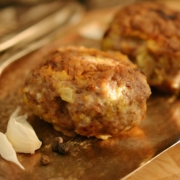
When you first move to Germany, you will notice that most of the German cuisine is based on meat dishes: not only will you taste the well-known sausages but you will  also have the chance to try out the German meatballs, which you can easily find at any local store. Although the most widespread is Fleishkloß, there are actually 15 ways to say “meatball” all over the country: they call them Frikadelle in Northwestern and Central Germany or Fleishküchle in the southwest. In Dresden and Leipzig they are known as Klops o Kloß; Fleishaiberl in Austria. Lastly, Bulette or Boulette are typical of Berlin.

We highly suggest you keeping in mind a few of these terms listed above so that you can figure out what you are about to eat!

BREAD

Talking about variations of words concerning food, we need to mention one of the essentials of everyone’s diet: bread and, more specifically, the last chunk of a loaf of bread. This term has loads of variations in Italian, according to the region it is associated with, such as “cozzetto”, “cantuccio”, “gomito”or “culetto”. However, there are more than 50 variantions in German: Kanten, Anschnitt, Kipf, Ranft/ Ränftchen, Knorze, Knust, Rankl, Krust, Kirshte and so on. In Switzerland Anhau, Scherz, Mürggu, Mutsch, Chäppi, Houdi  are the most used, while Scherzerl  is typical of Southern Germany and Austria.

HICCUP

Let’s change topic! There are at least 25 ways to hiccup in German. The first word that might cross your mind could be either Schluckauf or Schluchzer. You might hear people say Hädscher in the south of Germany and in the areas bordering France; Schnackler is a typical Austrian variation instead; lastly, Hitzgi is characteristic of Switzerland.

SLIPPERS

It is an easy-peasy word which has a lot of equivalents in German. You can’t go wrong if you use the word Hausschuhe, which literally means “house shoes”. However, there are 10 ways to say slippers. Pantoffeln sounds like Italian (pantofole) yet it is not spread over cities like Berlin and Hannover, just like Schluffen mostly used in Frankfurt and in the state of Rhine. Bambuschen, again similar to the Italian “babbucce”, is frequently used in the east of Germany. Lastly, if you are in Switzerland you will be more likely to hear Finken.

The German language is becoming easier and easier thanks to foreigners

The Germans and their language

Apparently, German people speak their language in a wrong way, grammatically speaking. The reason is quite simple: they want to simplify it. Mark Twain wrote in his book A Tramp Abroad: “A gifted person ought to learn English in thirty hours, French in thirty days, and German in thirty years.” It’s widely believed that the German language should be in a certain way renewed and refreshed. So, what’s going on with German? In 2008, two thirds of Germany’s inhabitants said that the quality of their language was becoming lower and lower: in fact, people tend to read less. Not to mention, the inexorable process of anglicisation.

Is Hochdeutsch disappearing?

The term Hochdeutsch refers to the most prestigious variety of German, the one without dialect and regional expressions. Needless to say, the spoken language – more flexible and open to cultural and linguistic transformations – easily removes the grammar’s barriers, typical of the written German. In the spoken German, not only the genitive case completely disappears, being replaced by different prepositions, but also word endings, concords and formal cohesion of the sentence inexplicably vanish. Grammatical structures of migrants’ languages, such as Turkish or English, tend to influence the language.

German and multilingualism

Language transformations are due to social changes: believe it or not, an increasingly growing process of immigration leads to a vast multilingualism. This actually means that the language is sensitive to social transformations and changes. In Berlin there are people from 189 different countries, and this contributes undoubtedly to the phenomenon of Multi Kulti Deutsch (multicultural German). There’s a good chance that “the systematic mistakes of today are the new rules of tomorrow”, as Rudi Keller, German linguist, states. To sum up, foreign languages affect inevitably national languages, and schools and universities should make aware of this kind of phenomenon.

Not only in Germany! 10 German words which are commonly used also in other languages

The German language: not as foreign as we think

It’s a fact, that learning German is not easy at all. Anyone who wants to learn this language must deal with a complex grammar, the existence of three genres (masculine, feminine and neutral), the length of the words and the basic unfamiliarity of each sound. In order to make the learning of German easier, we may remember that many words from German are actually used globally as an important part of the common language. For example, look at the following terms: Müsli, Strüdel, Kitsch, Bunker or Realpolitik. As we can see, the Teutonic influence is quite obvious in many different fields: food, culture, military or politics. Now, let’s focus on the most commonly used worldwide German words:

Hinterland

Literally meaning “the land behind”, is a common word in English, French, Spanish and Italian. Hinterland stands for “backcountry” or “a remote area of a country away from the city centre influenced by economics, society and culture”. For example, in Italy we often hear of “hinterland milanese”.

Schadenfreude

Common word used in English to express “joy” or “satisfaction” for one’s misfortunes. The Italian translation is “gioia maligna”.

Kindergarten

Literally “children’s garden”, it can be used in English as a synonym of “nursery school”.

Zeitgeist

This is a worldwide term used to express “the spirit of the time”. The expression comes from philosophy to indicate the ideal climate, culture and spirit (considered as characteristic of an era).

Wanderlust

Literally meaning “desire of walking” is commonly used in English in order to express “the craving for travel”.

Leitmotiv

Literally “guiding reason” is a global word which indicates “a motif or constant aspect of a literary or musical work” but also of “activities, manifestations and different behaviours”. Apart from the musical field, it has also become common to others.

Wunderkind

In English “wonder/prodigious child”.

Doppelgänger

It means in English “body double/alter ego”.

Spiel

Literally “play or game”. This term is used in English with the meaning of “eulogistic speech” or “long and boring speech”.

Delicatessen

Commonly shortened in Deli in English, Delicatessen means “culinary specialities shop”. The German word Delikatesse, which stands for “deliciousness”, derives from délicatesse, or “delicacy”.

10 German words that every language should have

They say that the language of a nations reflects its culture and mentality, even more so if there are words that can’t be directly translated in other languages.


These are precisely the most interesting words to study or observe with attention because they allow us to really grasp a different culture and norms. So here are 10 beautiful and intricate German words to learn:

#10 SCHILDERWALD

A forest of road signs. So many road signs that you’ll get confused by all the directions indicated and get lost.

#9 KOPFKINO

To have a mental movie going on. Well, to whom did it never happen? Imagining in our head the best and worst scenarios we would say.

#8 LUFTSCHLOSS

In English we would say “to build castles in the air”. Something desired, but far away from reality: a project or idea that can be hardly achievable.

#7 SCHNAPSIDEE

That crazy idea that you will get in a moment of absolute euphoria, at times caused by an excessive consumption of alcohol. Genius ideas that might reveal to be a total disaster or an acclaimed success.

#6 AHNUNGSLOSIGKEIT

The lack of knowledge, opinions, awareness. According to the context it might indicate being naive, ignorant or ingenuity.

#5 FINGERSPITZENGEFUEHL

An immediate awareness and empathy with our surroundings, that allows us to respond promptly and diplomatically.

#4 STREBEN

The origin of the term resides in the German romantic period, when this word indicated the detachment from everyday life to reach that intangible level of perfection. Today the term indicates the effort and determination required to fullfill one’s ambitions.

#3 GEBORGENHEIT

Most of the dictionaries translate this term simply as “certainty”. In reality there are many more nuances that go over and across the meaning of this word: an incredible combination of certainty, protection and intimacy derived from relations with others, in particular your family.

#2 VERSCHLIMMBESSERN

Making a situation worst in the attempt of making it better. Like trying to fix that bad haircut at home on your own..

#1 WANDERLUST

The desire to leave. That uncontrollable itch that makes you want to travel and explore the world, see new places and make new experiences.

————

Are you getting intrigued by the German language or wish to refine your vocabulary? Then take a look at the German courses that Berlino Schule organizes! 

10 indispensable dialectal terms if you are in Bavaria

A rich region, cities full of history, gorgeous forests, and beer flowing to rivers. These are just some of the reasons why a visit to Bavaria is a must.
Incomprehensible to the profane – even those not fasting from Hochdeutsch, the German standard – Bavarian dialect is an indispensable element to live fully in Munich and the surrounding area. Here, there are newspapers and television broadcasts in Bairisch, which are sometimes hard to understand even for a northern German, and certain terms, at least the basic ones, can be useful for getting in touch with locals more easily. We chose ten of them, just to give you an idea.


Medieval greetings: Grüß Gott and Servus.

The Bavarians have their own way to greet each other. Forget the Hallo and Guten Tags that you learned in school and unlock the religious Grüß Gott, literally “greeting God”, but translatable as “good morning” or “hello”. Or, if you want some other feudal suggestion, you can use Servus, literally “slave”. A greeting formula that can be used even to say goodbye to someone.


Buam and Madln, ladies and gentlemen.

Sometimes you can find these two terms on the toilet door, and if you miss the pictures, you may get confused. So, better to know that Buam is used for men, Madln for ladies.

Dirndl and Lederhosen: the traditional clothes.

You will have seen them a thousand times, at the Oktoberfest or any in any stereotyped representation of Bavaria, but you never remember the precise name. Well, the Dirndl is the typical gown of the Bavarian (and also Austrian) ladies, while the Lederhosen (which, strictly speaking, is not a dialectical term) are the traditional leather pants worn by the young.

Fesch, or “attractive” or even “fresh”

It is the equivalent of the German standard hübsch. You could, for example, hear it in conjunction with Madl in a phrase like Ja mei, was für ein fesches Madl ! : “What a beautiful girl!”


Schmarrn, if someone says nonsense.

The Schmarrn (or Schmarren) is originally a dish (similar to a pancake) but, figuratively, it is also used as a derogatory expression, to mean “nonsense”, when someone is saying something unwise or fake .


The equivalent of oder: Gell.

As you may know if you have been living somewhere in Germany, Germans usually used “oder?” or more colloquially, “ne?” at the end of the sentence to stimulate the response of others. It is the equivalent of our “or not?”, “is not it?” Even in this case the Bavarians stand out, and their particle for this function is “gell”.


I mog di, or “I like you”.

f you are talking to a Buam or a Madln really fesch and want to declare it, you will need to use these simple words: I mog di, “I like you”. It will not be too hard to remember, given the similarity with the Hochdeutsch, Ich mag dich.

When you leave: Pfiat of.

Probably, in your opinion, you will be accustomed to the classic Tschüß or Hello. In Bavaria, they use as usual a formula that has a religious etymology: Pfiat of, which literally meant “God Protect You”. Anyways it is a nice way to say hello, right?


Give your consent: freilich.

Those who live in northern Germany, you will be used to give your consent or approval after a question by using terms like natürlich – of course – or selbstverständlich – obviously, of course. In Bavaria you will need to reset on freilich. A bit of patience.


Maß, the Bavarian beer unit.

To what do you think it equates to? One liter, of course. Do not try to get a beer below the Maß, or you might as well not drink at all.

————

Are you getting intrigued by the German language or wish to refine your vocabulary? Then take a look at the German courses that Berlino Schule organizes! 

5 German expressions that you won’t forget easily

Are you studying the language of the devil and you don’t know to which saint to turn to anymore? No panic! We put together an exhaustive list of common German expressions that you will hardly forget. So close your grammar books and follow us!


1. Arschgeige (r. Arsch = ass, e. Geige = violin); literal translation, dipstick / dipshit/ arsehole

The typically German mastery of composing and using of composite words is known throughout the world. Our teutonic hosts have invented all sorts of these, both when sober and under the influence of susbstances. Arschgeige belongs to the second group.

2. Arschbombe (r. Arsch = ass, e. Bombe = bomb); literal translation, cannon ball

We continue the list of composite words with “ass”. And no, it is not referring to the effects of lactose on your flatmate, but to the jumping in the water in a cannon ball.

3. Arschloch (r, Arsch = ass, s. Loch = hole); literal translation, asshole / twat and so on

Yes, if you hear someone calling you an Arschloch you have every right to get mad.

4. Ich habe die Nase voll davon; literal translation, my nose is full / I’ve had enough

From the ass to the nose. This nice and colorful expression is used to describe situations, people, places, things, cities, etc. of which one has had enough of. It is a highly versatile and effective expressive.

5. Null – acht – fünfzehn; literal translation, zero – eight – fifteen

Did you know? Even with numbers you can say so many things in German. Especially if their combination refers to a heavy machine gun used by the German army in World War I. Surely you will have seen it in some documentary or vintage movie, but what you may not know is that in 1914 the infantry’s army’s automatic weaponry was about 12,000 more than the one in the other armies. The Germans were so fond of using the model number as an expression to indicate not an erotic position, but a mediocre person. Evidently the gun did not work very well.


Cover Photo: © Nina Helmer CC BY-NC ND 2.0


Want to learn German in a vibrant environment? Look no further and check out the German courses that Berlino Schule organizes by clicking here!

Brad Pitt nominated as testimonial of the German language in the world. Here’s why.

Throughout his career Brad Pitt has been called a lot of things, but surely he missed the title of being “a promoter of the German language”.

When not busy with the big screen or with humanitarian actions, the actor added another talent to his extensive curriculum. We are talking about the nomination to the tile of Sprachwahrer for the year 2014, an initiative promoted by the notorious German newspaper “Deutsche Spachwelt”. The award was given to someone that has demonstrated its dedication to the language, giving it value and merit. We can therefore define them as “language promoters”.

The actor, that has distant German origins, is in fact one of the most famous German scholars as well as a regular visitor of the country. We recall Tarantino’s “Inglorious Basterds” of 2009 that was shot in the studios of Studio Babelsberg in Potsdam. Estimator of the Teuronic art, he expresses with enthusiasm his passion for the language by saying “I like German, I even find it beautiful and melodious” as reported in Kölner Express.

The title is, however, very controversial and amongst the other formidable contenders we remember: Monika Gruber, the German cabaretist famous for her politically correct linguistic manipulation, Heike Diefenbach and Michael Klein with their battle fought with words and petitions, working towards an ideological and free scientific language. Last but not least Johannes Singhammer, vice-president of the German Parliament, appointed for his tireless actions in promoting the German language.

Amongst the winners of the previous editions we remember the Deutsche Bahn (the German railway), Loriot (a famous German comedian, in 2011) e pope Benedetto XVI (in 2005).

Photo © Red Romero Ramos CC BY SA 2.0


Wish to become like Brad and get nominated yourself as “promoter of the German language”? Then take a look at the German courses that Berlino Schule organizes in the heart of Berlin by clicking here!


How to memorize 18 German words without getting a headache

German continues to be a source of inspiration in many ways. The fact that it is still a cryptic language for many is not a novelty.

Learning German is for many an impossible task due to, amongst other things, the many consonants placed close to each other and the rigid pronunciation of words. The structure of the sentences, the syntax, still puts the most talented Germans in crisis. The Germans themselves often admit that they do not know the meaning of a term and therefore use the famous Richard Porson’s saying that “life is too short to learn German.”

German words

To make the whole thing even more grotesque is the (in)famous German morphology with its endless composite words, one of which has even entered the Guinness Book of Records as the longest word in the world: Rechtsschutzversicherungsgesellschaften (companies that provide legal assistance). And if long words were not enough, then there are those that in a few syllables contain a myriad of different meanings, impossible to synthesize in English in one word. Here is a list of the most bizarre and astrus ones selected by the site Fluentu!


18. Ohrwurm= earworm [for instance when you hear a song on the radio and can’t get it out of your mind throughout the whole day]


17. Fernweh= longing for a distant and unknown place


16. Kummerspeck= literally, grief bacon, in context it is having an emotional belly [or the need to eat to console your belly following a disappointment]


15. Innerer Schweinehund= inner pig/dog [it is that very powerful animal that lives within us that we must overcome when we have to do unpleasant things, like paying taxes and going for a jog at 6am before work]


14. Fremdschämen= feeling shame for someone else


13. Torschlusspanik= panic of the closed door [it is commonly employed to address a woman whose biological clock is ticking]


12. Treppenwitz= staircase joke [it occurs when the right joke comes to your mind when it’s too late, as if you have a pleasant meeting on the stairs and you have no time to say the right thing]


11. Lebensmüde= life tiredness


10. Weltschmerz= pain of the world


9. Weichei= soft egg [N.B. never say that to a waiter in Germany, for the actual meaning of the term is to address someone that is cowardly and has “soft balls”]


8. Backpfeifengesicht= face you would like to slap


7. Erklärungsnot= need to explain [have you been punished and didn’t even have the time to realize it? Then claim your Erklärungsnot!]


6. Sitzfleisch= seat meat [a character trait, to have big shoulders. For the German collective imagination it is like having a sac of meat on your seat due to an excessive state of boredom]


5. Purzelbaum= tumble tree [Somersault! Roll on the floor as if you were a piece of tree trunk]


4. Dreikäsehoch= three, cheese, above [a term for children employed towards that kid in the class that is taller compared to others, as tall as three pieces of cheese on top of another]


3. Zungenbrecher= tongue twisters [read about hilarious German tongue twisteres here]


2. Schattenparker= shadow parker [are you trying to be smart and park your car in the shade to protect it from the heat? This term is not actually meant as a compliment, but more as an insult]


1. Kuddelmuddel= unstructured mess


If you read until here and now your head is fully of screws and you are thinking that the German language is like a witty mosaic, an unstructured mess, then this is the word that you need right now.


Do not be discouraged, German is a very charming language and with some commitment everyone can succeed in mastering it. And studying German is also a good way to overcome the sense of Lebensmuedigkeit and stop using google translate which, let’s say it, never gets it right. And additionally to be taken for a Schattenparker that doesn’t commit does not please anyone. In the end, there are surely other Weltschmerz that are worse than learning German. After a thousand Kummerspecken overcome thanks also to the strength that you have gained by experiencing the Torschlusspanik, you can go out with your German friends and also take their order when you go to the restaurant. And this time without any of them feeling Fremdschämen for you.

You can finally be totally proud of having overwhelmed your Innerer Schweinehund. It is the same feeling of when, as a child, you felt so powerful after succeeding in a new intent. When you felt that you stood out like a Dreikäsehoch. You have gone a long way and now you have your Sitzfleisch. After a thousand nights spent on a thousand absurd Zungenbrecher until they become actual Ohrwurm. You will not be considered a Weichei anymore, and surely this time you will be able to talk to your new neighbors without fear of falling into any Treppenwitz. Except if it’s your girlfriend, in that case you’d risk a proper Backpfeifengesicht. Be careful not to combine any Kuddelmuddel or to use your Erklärungsnot!

If after all this you still want to stay and do not experience any sea sickness or Fernweh, there is nothing left to say or do than return to your inner child and gain thousands of well earned Purzelbaum!

Cover photo: © Alexandre Normand CC BY SA 2.0


Want to learn German in a vibrant environment? Look no further and check out the German courses that Berlino Schule organizes by clicking here!